
¡¡
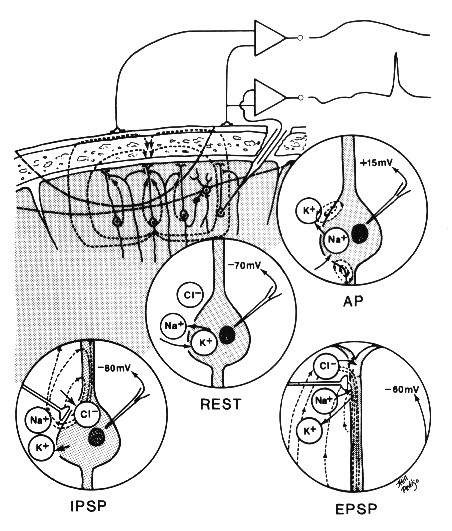
Fig. 1 The generation of the EEG by the cerebral cortex. Scalp electrodes record potential differences which are caused by post synaptic potentials in the membrane of cortical neurons. The closed loops of the lighter dashed lines represent the summation of extracellular currents produced by the post synaptic potentials; the open segments of heavier dashed lines connect all points having the same voltage level. The two scalp electrodes are at different voltage levels and record this difference, as it changes with time, in the form of a wave which is indicated by the first of the two tracings at the upper right. A simultaneous recording made with a microelectrode from a single cortical neuron is indicated by the second tracing and bears no close relation to the scalp EEG. The round insets show the major ionic and electrical events at single neurons. REST: The uneven distribution of ions across the cell membrane, partly maintained by the semipermeable membrane, partly by the active extrusion of sodium ions and intrusion of potassium ions. causes a steady potential difference of 70 mV recordable with an intracellular microelectrode. IPSP: An inhibitory post synaptic potential is caused by activation of an inhibitory synapase on the cell body which transiently increases the permeability of the post synaptic membrane to potassium and chloride ions and thereby increases the membrane potential, generating electrical current flow of decreasing intensity along the cell membrane. EPSP: An excitatory post synaptic potential, caused by activation of an excitatory synapse on a dendritic process of the neuron, causes a nonselective increase of permeability to ions including sodium ions and thereby transiently decreases the membrane potential locally, generating current flow which tends to depolarize the membrane of the cell body. AP: An action potential is initiated at the axon hillock of the cell body by the summation of excitatory post synaptic potentials which reduce the membrane p0tential to a level at which the membrane suddenly becomes freely permeable to all ions so that the membrane potential momentarily collapses and reverses; local current flow depolarizes neighboring membrane parts and results in the propagation of an action potential along the membrane of the cell body and axon.
¡¡