
¡¡
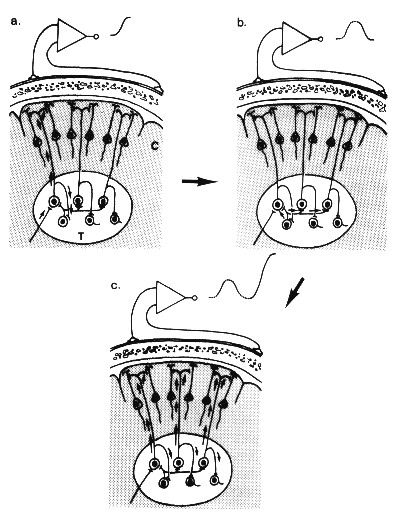
Fig. 2. Steps in the production of rhythmical EEG activity in the cortex (C) as proposed by the facultarive pacemaker theory. (a) A thalamocortical relay neuron (TCR) in the thalamus (T) is excited by an afferent neuron and sends an impulse simultaneously to cortical neurons and to an inhibitory thalamic interneuron. Postsynaptic potentials of cortical neurons generate the first deflection in the cortical EEG. (b) The output of the inhibitory thalamic interneuron suppresses the activity of several TCR neurons. The resultant disappearance of postsynaptic cortical activity represents the end of the first deflection of the cortical EEG. (c) Several TCR interneurons, simultaneously released from inhibition by interneurons, send synchronous impulses to cortical neurons, causing another larger deflection of the cortical EEG. Simultaneous impulses to larger numbers of inhibitory thalamic interneurons initiate the next cycle of rhythmical activity.
¡¡